
Carving to JaPOW | Snowboarding in Three Dimensions
How to adapt familiar fundamentals so you can keep moving on top of and within the deep stuff.
Same Fundamentals. Different Environment.
In our previous article, Carving Isn’t Magic. It’s Style With Intention, we explored how edge angle, inclination, angulation, momentum, and pressure work together to create different outcomes on firm snow.
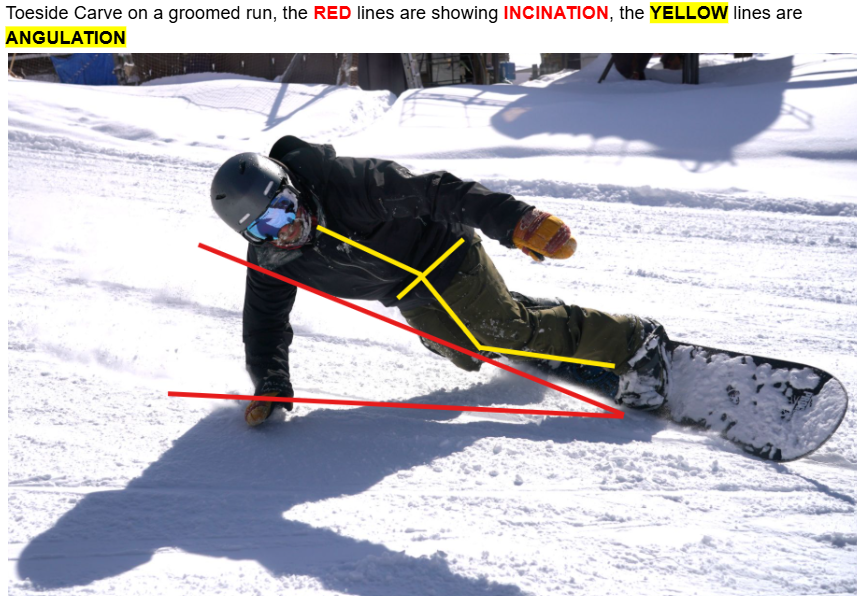
But what happens when we take those same principles into Japan’s famously deep powder?
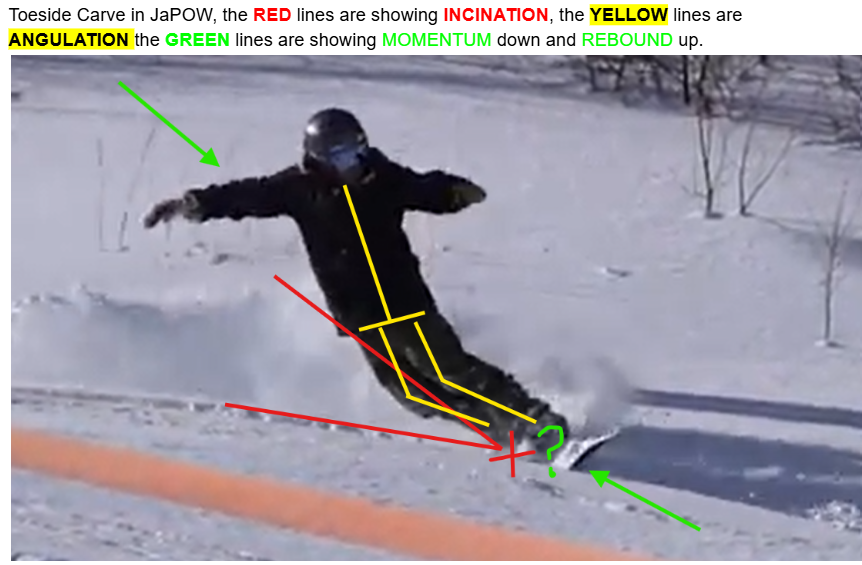
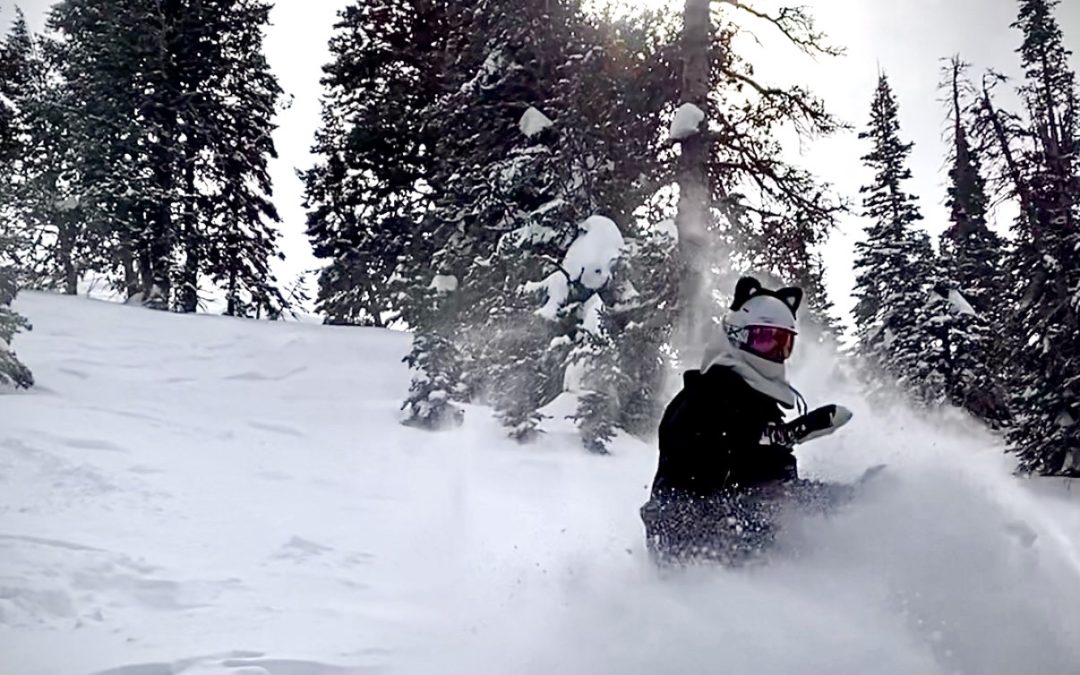
Suddenly, the edge that provided so much of our support on a groomed run becomes less important. Our equipment begins interacting with the snow across a much larger surface area. Instead of primarily traveling across the surface, we can move both on top of and within it.
We’re no longer limited to the two-dimensional relationship we experience when carving on firm snow. Powder introduces a third dimension, where float, pitching, and rebound become important considerations.
The fundamentals haven’t disappeared. The supporting surface has changed, and with it, the way we use those fundamentals.
From Edge Grip to Float
When carving on a groomed run, the snowboard’s edge cuts into a relatively firm supporting surface. As the board travels along its curved edge, the snow provides the reaction force (the wall we push against) necessary to redirect our momentum.
In powder, that relationship changes.
Rather than relying primarily on a narrow edge, we’re using more of the board’s base to displace and compress snow. The amount of support we receive depends on several variables, including snow density, speed, board design, and how we distribute pressure.
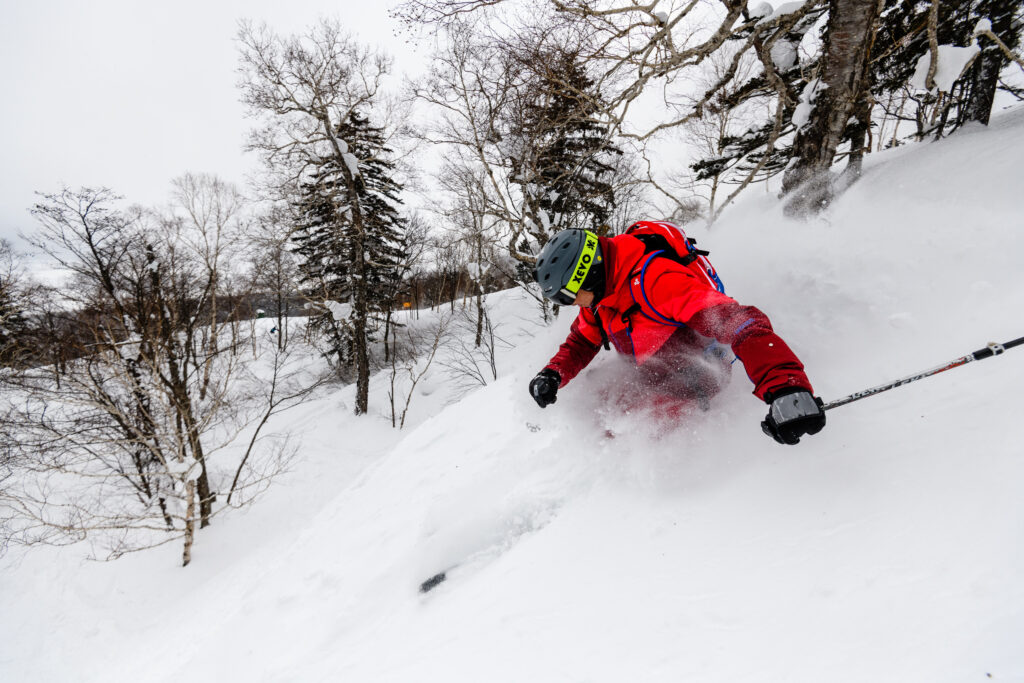
Japan is particularly famous for its light, dry snow. Exceptionally low-density powder might contain only 5–8% water by weight, although actual conditions vary considerably.
In this environment, our equipment can sink deeper into the snow, and the snow itself moves around us.
This creates an interesting challenge: How do we generate enough support to redirect our momentum when the surface beneath us is constantly moving?
One answer is speed. As our equipment moves through the snow, it displaces snow and generates resistance. That resistance contributes to the support we feel beneath our feet.
Another is surface area. The more effectively we distribute pressure across the supporting portions of our equipment, the more opportunities we have to manage float and direction.
But perhaps the most interesting variable is how we move.
Riding ON the Snow Versus IN the Snow
Not all powder behaves the same way.
Sometimes denser snow, like you might find in the Pacific Northwest, provides enough support that our board rides relatively close to the surface. Other times, we find ourselves submerged in lighter, airier snow, like you might find in Utah, with snow surrounding much of our equipment and even our legs.
Both types of POW are incredibly fun, but they ask us to adapt differently to find maximum flow and satisfaction.
When we’re closer to the surface, we may have more freedom to use movements that resemble traditional carving. As we sink deeper, we often need to become more deliberate about managing pressure, maintaining momentum, and creating opportunities to redirect our equipment.
Watch: Active Angulation in Japan Powder
Notice how the rider manages their body position while the snowboard travels relatively close to the snow’s surface.
Compare: Snowboarding Through Deep Japan Powder
Now watch how the rider’s equipment moves within the snow. Consider how the increased resistance might change their ability to steer, extend, or recover from an unexpected movement.
The difference isn’t simply about better or worse technique. It’s about adapting to the support that’s available.
Creating Support and Rebound on a Cloud
One of the most enjoyable sensations in powder is the feeling of rising and falling through successive turns.
But where does that movement come from?
On firm snow, we can create substantial pressure by increasing edge angle and directing our momentum against the supporting surface. We may also bend the equipment, storing energy that can contribute to rebound as that pressure is released.
Deep powder provides a different opportunity.
By extending our legs and directing pressure into the snow, we can compress and displace the supporting surface. Depending on snow density, speed, and timing, that interaction can create a temporary increase in support.
The rider can then use that support to help move their equipment upward, reduce resistance, and prepare for the next turn.
The sensation may feel like bouncing, floating, or surfing. But rather than relying on a firm edge, we’re working with snow that can compress and move.
Two Different Approaches
Skiing: Creating Support Underfoot
Watch Siamac skiing powder at Alpine Meadows.
Watch: Powder Skiing — Rebound Underfoot
Notice how he uses relatively quick extensions through his legs to increase pressure against the snow. As his skis gain support and rise, he can retract his legs and redirect the equipment into the next turn.
The movements are subtle, but their timing is important.
Snowboarding: Creating Support Through the Tail
Now watch Kara riding powder in Japan.
Watch: Japan Snowboarding — New Heights
Focus on 0:22–0:25 and 0:34–0:38.
Kara uses a different approach, directing more pressure toward the tail of her snowboard.
This changes the board’s pitch, helping the nose rise while the tail interacts more deeply with the snow. The combination of pressure, board shape, and momentum can create an opportunity to lift and redirect the equipment.
It’s important to recognize that simply leaning backward isn’t the goal. Excessive rearward balance can overload the back leg, reduce steering options, and make it difficult to maintain momentum.
Instead, we’re exploring how intentional fore-aft pressure changes the relationship between the snowboard and the snow.
Something to explore: When watching these two riders, notice what happens immediately after they create support. Do they remain extended, or do they allow their legs to flex and their equipment to move closer to their bodies?
Often, it’s this combination of extension and retraction that makes the next movement possible.
Steering Through Powder
Creating support is only part of the challenge. We also need to decide where we’re going.
On firm groomed snow, a snowboard’s sidecut and engaged edge can do much of the work of establishing a curved path.
In deep powder, steering can involve a different combination of movements.
We can blend fore-aft pressure, rotation, inclination, angulation, and vertical movement to change the direction and orientation of our equipment.
Sometimes we want the snowboard to travel smoothly along a broad arc. Other times, particularly in tight terrain, we need to redirect it more quickly.
One useful option is counter-rotation: allowing the upper and lower body to rotate in opposite directions.
When timed appropriately, this can help reposition the snowboard while the upper body remains oriented toward the intended direction of travel.
However, counter-rotation is only one option. We can also steer through coordinated rotation of the legs, changes in pressure, and adjustments to the snowboard’s relationship with the snow.
The important question isn’t which movement is universally correct.
It’s which combination of movements produces the outcome we need in that moment.
Watch the Movements Work Together
Watch: Japan Snowboarding — Steering Through Powder
Focus on 0:40–1:18.
Watch how the snowboard changes direction relative to the rider’s upper body.
Notice when the rider creates pressure against the snow and when the board becomes easier to redirect.
What might happen if the rider tried to rotate the snowboard without first creating enough support or reducing the resistance surrounding the equipment?
This is where powder riding gets really interesting. The timing and blending of movements can matter just as much as their size.
Reading Terrain: Where We Want to Go Versus Where We Can Go
Some of Japan’s most memorable powder riding happens among the trees.
But trees add another layer of complexity.
Our line choice becomes a negotiation between where we want to go and where we can safely travel while maintaining enough momentum to keep moving.
In open terrain, we may have the freedom to experiment with different turn shapes, speeds, and movement patterns.
In the trees, those choices become more consequential.
A turn that creates too much resistance can leave us stranded in deep snow. A turn that doesn’t redirect enough momentum can send us toward an obstacle. And reacting only to what’s immediately in front of us can make it difficult to maintain a smooth, predictable path.
Successful tree riding begins with looking ahead and identifying a line that gives us options.
We need to consider not only the next turn but also what comes afterward.
Where can we maintain momentum? Where might we need to reduce speed? What happens if we need to stop? Is there a safe way out?
Watch: Japan Tree Riding — New Heights
Successful examples: 1:46–2:40. More challenging examples: 2:42–4:35.
Notice how the riders who maintain flow position themselves for the next opening rather than simply reacting to the closest tree.
When things become less successful, consider whether the challenge comes from movement choices, line selection, insufficient momentum, or some combination of all three.
And remember that tree riding introduces real hazards, including tree wells, deep-snow immersion, hidden obstacles, and difficult exits. Appropriate terrain selection, partners, and safety preparation are essential. The goal isn’t to maintain speed at all costs.
Practice Reading Your Line Before the Powder Arrives
A great way to develop your line-reading skills is to practice in suitable, widely spaced tree terrain when the snow is soft but not especially deep. That way, you can stop without worrying about getting stuck.
Start by choosing a safe line for a single turn. Visualize the path, commit to it, execute the turn, and come to a controlled stop.
Once you can consistently execute one planned turn, try planning two turns before stopping. Then progress to three.
With practice, you’ll begin to develop the ability to look farther ahead, plan your next movements while still executing the current ones, and make proactive decisions when something unexpected appears.
The goal is to become less dependent on last-second reactions and more capable of maintaining a smooth, intentional line.
When the powder finally arrives, you’ll already have a valuable set of skills for navigating it.
What Changes from Groomers to Powder?
Although the same fundamentals apply, the ways we combine them can look quite different.
| Element | Firm Groomers | Deep Powder |
|---|---|---|
| Supporting surface | Primarily the engaged edge during carving | Larger areas of the base interacting with moving snow |
| Pressure control | Often progressive through a carved turn | May include more pronounced extension, retraction, and pressure pulses |
| Turning mechanics | Edge angle and sidecut strongly influence the path | Pressure distribution, equipment pitch, rotation, and snow resistance become increasingly important |
| Balance | Managing forces over a relatively firm surface | Managing support while equipment moves on and within the snow |
| Turn shape | Clean arcs determined by edge engagement and equipment geometry | Flowing arcs, pivots, and more variable paths depending on conditions |
These aren’t mutually exclusive techniques. We can carve in some powder conditions, and we can use rotation, pressure changes, and pivoting movements on firm snow.
Continue Learning
If you’d like to see these ideas in action, revisit the video examples throughout this article and compare how each rider manages support, pressure, and direction. You can also Watch this Video of our Tech Talk Tuesday from November 4, 2025 where we discussed this topic
You can also explore our previous article, Carving Isn’t Magic. It’s Style With Intention, for a closer look at the mechanics that connect these different environments.
And if you’re interested in exploring these ideas with a group of experienced riders and coaches, our Hidden Hokkaido and Wild Wasatch sessions use mountain terrain as the classroom, combining exploration with intentional progression.