The Trick List | Building Your Freestyle Progression
Learning a new trick is exciting. Discovering how that trick connects to everything else you can do is where things really get interesting.
Freestyle snowboarding offers an almost endless collection of possibilities. Jumps, grabs, spins, presses, slides, and combinations can keep us exploring for years.
But with so many possibilities, deciding what to learn next isn’t always obvious.
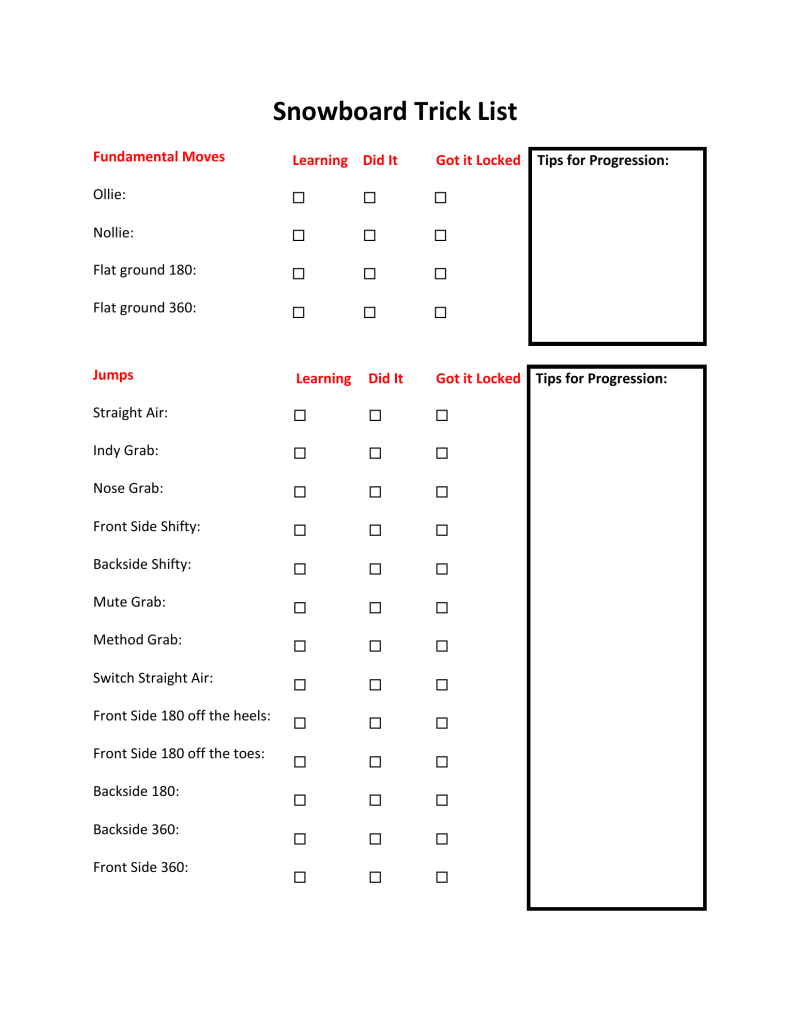
Years ago, I created a Snowboard Trick List to help riders organize their freestyle progression. The idea was simple: give people a collection of tricks to explore, organized in a way that helps them recognize how skills build on one another and identify what they might want to try next.
The list begins with fundamental movements on a groomer and gradually introduces more complex tricks on jumps, boxes, and rails.
But it’s not intended to be a rigid checklist that everyone must complete in the same order.
It’s a tool for recognizing connections between skills, identifying opportunities for progression, and making more intentional decisions about what to practice next.
Learning It, Doing It, and Owning It
One of the most important features of the Trick List is its three stages of progression.
Learning: You’re exploring the movement, understanding what needs to happen, and beginning to experiment.
Did It: You’ve successfully completed the trick. That’s worth celebrating, but it doesn’t necessarily mean you can repeat it consistently.
Got It Locked: You can perform the trick reliably, with enough understanding and control to adapt it to different situations.
That distinction matters.
Landing a trick once is exciting. But being able to reproduce it, refine it, and eventually take it to different terrain, features, and conditions is where true ownership develops.
At that point, the trick is no longer an isolated accomplishment. It becomes part of your riding, something you can draw on naturally, adapt to the environment, and blend with other movements to create something new.
And that kind of progression can be every bit as rewarding as learning another trick.
Progression Isn’t Just About the Next Trick
It’s tempting to measure freestyle progression by the number or difficulty of tricks we can land. Learn an ollie, move to a 180, then a 360. Keep adding tricks and increasing difficulty.
There’s nothing wrong with that. Learning something new is exciting, and pursuing more challenging tricks gives us compelling goals.
But progression has another dimension.
Consider a rider who has learned a backside 180. They might initially land it on a small jump under familiar conditions. That’s an accomplishment worth celebrating.
Now imagine taking that same trick to a different jump, performing it with a different approach, changing the timing or amplitude, or using it to enter or exit another trick.
The trick hasn’t necessarily become more difficult on paper, but the rider’s understanding, versatility, and ownership have grown considerably.
Vertical progression expands what you can do. Lateral progression expands what you can do with it.
These two approaches aren’t competing with each other. In fact, they often support one another. Learning a new trick can improve your understanding of an existing one, while developing greater ownership of familiar movements can make more advanced tricks accessible.
The goal isn’t to finish one trick completely before moving on to another. It’s to recognize that learning something new and developing ownership are both valuable forms of progression.
And when we give both vertical and lateral the attention they deserve, freestyle progression becomes a much bigger playground.
Put the Trick List to Work
Whether you’re just beginning to explore freestyle or have been riding the park for years, the Trick List can help you identify your next challenge.
Download the list, take inventory of the tricks you’re learning, the ones you’ve landed, and the ones you’ve truly got locked.
Then consider revisiting something familiar. Could you take it to a different feature, change the approach, add a grab, or combine it with another trick?
Remember, getting a trick locked doesn’t mean you’re finished exploring it. Sometimes the most rewarding progression comes from discovering something new in a movement you thought you already knew.